
TCP vs UDP: Key Differences Between TCP and UDP
Quick Navigation
If you become enthusiastic about computer networking, or if you have explored through some apps’ network settings, you probably know the terms: TCP & UDP. Transmission Control Protocol or TCP, and User Datagram Protocol or UDP, are components of the internet protocol suite or IP suite. TCP and UDP are different procedures to transmit data across the web.
But, even knowing what TCP & UDP stand for, it is difficult to know which protocol to use, or why to utilize one over the other. However, in this article, we will head to basic computer networking, the differences between TCP vs UDP (TCP versus UDP), and many more.

What is TCP?
TCP or Transmission Control Protocol is a connection-aligned protocol that PCs use to communicate on the web. It is one of TCP/IP networks’ major protocols. TCP offers error-checking and ensures delivery of information & that packets (a formatted unit of data) will be supplied in the order they were transmitted.
The TCP/IP protocol comprises four layers such as network layer, link layer, application layer, & transport layer. Each layer puts on addresses to the protocol stack or network stack as a logical address, physical address, app-specific address, & port address.
What is UDP?
UDP or User Datagram Protocol is a connectionless protocol that functions just like TCP or Transmission Control Protocol. But, recovery services & error-checking are not needed. As an alternative, UDP continuously transmits datagrams to the receiver whether they obtain them or not.

Difference Between TCP & UDP
What is TCP vs UDP? TCP and UDP have lots of differences as well as similarities. Nonetheless, TCP & UDP are the most commonly utilized protocols for transmitting packets on the web. These protocols both function on the internet protocol suite’s transport layer.
Connection vs Connectionless
TCP is a protocol that is connection-oriented and UDP is a protocol without connection. The Transmission Control Protocol sets up a connection between a sender & receiver before information can be transmitted. UDP doesn’t set up a connection before transmitting data.
Reliability – TCP vs UDP
TCP is extremely reliable. TCP protocol guarantees to deliver the data to the receiver. If data is lost in the process, TCP will recover it and send it again. Also, TCP will inspect packets for errors and will track packets so that information will not be corrupted or lost.
On the other hand, UDP is not reliable. UDP doesn’t guarantee data delivery and the datagram packets might be lost or corrupted in transit.
Flow control – TCP versus UDP
TCP utilizes a flow control procedure that guarantees a dispatcher isn’t overwhelming a recipient by transmitting excessive packets simultaneously. TCP keeps information in a send buffer and obtains information through a receive buffer.
If an app is all set, it will read the information via the receive buffer. When TCP’s receive buffer is full, the recipient will not be able to manage more units of information and will let go of it. To keep the amount of data that is transmitted to a recipient, the beneficiary informs the sender of the available spare room. When a packet is acquired, the sender will receive a message with the current receive window’s value.
In contrast, UDP doesn’t issue flow control. With User Datagram Protocol, packets achieve in a constant stream or drop the packets.
Install Surfshark on Firestick
Ordering – TCP vs UDP
TCP performs sequencing & ordering to ensure that packets transmitted from a server will be supplied to the client just like they were transmitted. UDP or User Datagram Protocol, however, transmits packets in random order.
Speed – TCP versus UDP
With regard to speed, TCP is slower compared to UDP because it has tons of tasks to do. Transmission Control Protocol (TCP) has to check errors, set up a connection, and ensure that files are obtained in the same manner they were transmitted.
Usage – UDP vs TCP
Transmission Control Protocol (TCP) is best to use for apps that need high reliability where timing is a bit of a requirement.
- Secure Shell (SSH)
- World Wide Web (HTTP or HTTPS)
- Email (SMTP, IMAP, or POP)
- File Transfer Protocol (FTP)
UDP is best to use for apps that need speed & efficiency.
- Streaming videos
- VPN tunneling
- Live broadcasts
- Online games
- Voice over Internet Protocol
- Domain Name System
- Trivial File Transfer Protocol
YOUR INTERNET ACTIVITY IS BEING WATCHED
ReviewVPN cannot attest to the legality, security and privacy of the applications discussed on this site. It is highly recommended that you use a VPN service while streaming or using Kodi.
Currently, your IP 52.167.144.196 is visible to everyone and your Browser is being tracked by Advertisers & ISP Provider.
Here are the main reasons why you must use a VPN:
- Your activities are hidden from your ISP, the government, and from the apps you are using.
- You can access additional movies and TV streams.
- ISP attempts to throttle are thrwarted thus reducing buffering issues.
- Geographically restricted content like Netflix and Hulu can be unblocked.
A VPN works be replacing your ISP-assigned IP address and creating an encrypted tunnel. We recommend the no log service offered by IPVanish. It works well on a Firestick and offers the fastest possible speeds.
TCP IP vs UDP – Which is Faster?
Generally, UDP is the fastest internet protocol.
User Datagram Protocol (UDP) is a lot simpler and does not set up a connection between devices before transmitting data. UDP doesn’t also verify all the data if it arrives. It simply transmits data to the device that asks for it. It keeps performing that until the device disconnects or there’s no data to send.
TCP Application/Implementation
Below are the pros or benefits of using TCP:
- TCP operates independently of the OS
- It helps to establish a connection between various types of PCs
- It allows internetworking between the organizations
- Supports various routing-protocols
- You can operate it independently
- You can use TCP to establish a connection between two PCs
- It supports a number of routing protocols
UDP Application/Implementation
Below are the pros or benefits of using UDP:
- The UDP technique is largely utilized by time-sensitive apps and by servers that reply to small questions from a huge client base
- It works well with packet broadcasts for transmitting all across the network as well as for multicasting sending
- Also, the UDP is used in Voice over IP, online games, & Domain Name System
Disadvantages of TCP
Below are the disadvantages of utilizing TCP:
- TCP never wraps up a transmission without every single data in motion being clearly requested
- You cannot use TCP for broadcast/multicast transmission
- It has no block boundaries, thus there’s no need to generate your own
- This protocol offers numerous features that users don’t want. This may waste time, effort, or bandwidth.
- The transport layer doesn’t guarantee packets delivery
- It’s not easy to replace protocol in TCP
- TCP doesn’t provide clear separation from its interfaces, protocols, & services.
UDP Disadvantages
Below are the disadvantages of utilizing UDP:
- In UDP, a packet might not be conveyed or sent twice. It might be conveyed out of order, thus you obtain no indication
- Routers are totally careless with User Datagram Protocol, thus they never resend it if it comes into conflict
- It has no flow control & Congestion Control
- UDP tends to have worse packet loss
When to Use TCP & UDP?
- TCP comes along with associated overhead. Thus, when nearly all overhead is connected, your app stays connected for any time span
- UDP is perfect to use with multimedia such as Voice over Internet Protocol (VoIP)
- You may use TCP sockets when the client & server independently transmit packets. However, it is acceptable to have an occasional delay
- You use UDP if the client & server separately transmit packets. Nonetheless, it is not acceptable to have an occasional delay
Always Use A VPN While Using The Amazon Firestick
Using Virtual Private Network or VPN can be very useful. Thanks to a VPN service, internet users can access platforms, services, or websites that are unavailable in your country or bypass restrictions that numerous platforms sometimes impose.
When you utilize the internet, an encrypted Virtual Private Network service provider is highly recommended to conceal your activities on the internet, identity, as well as location. Many web users prefer Surfshark service for speed, privacy, & price. Offering superfast servers and astounding live chat support, Surfshark is also an easy-to-use app. Ensure to turn the Surfshark on when you’re using the internet.
Surfshark Features:
- Unlimited simultaneous devices
- Unblocks Netflix, Disney+, and lots more
- 30-day money-back guarantee
- Great download speed
- Robust encryption
- Great customer service
- Zero log policy
- Compatible with Windows, Android, iOS, Linux, and other routers
Click here to get the lowest price on Surfshark through our exclusive limited-time offer.
How to Install Surfshark VPN on Firestick
If your Firestick still has the older interface, read this article to learn how to update it: Update Firestick Interface.
Follow our screenshots below to install the SurfShark VPN app on your Fire TV stick.
1. Go to the Home screen of your Firestick.

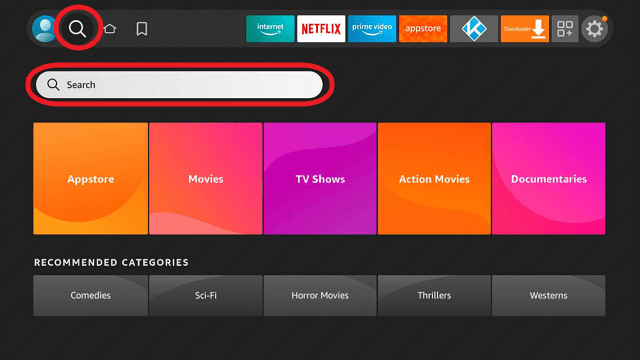
2. Navigate towards the Find tab. Press the Search button from the resulting dropdown.
3. Type in the keyword of SurfShark and select from the suggestions that will appear.

4. Click the official SurfShark icon from your search results.

5. Press the Download (You own it) button.

6. The SurfShark VPN installer will download on your device.

7. SurfShark VPN’s app will automatically install itself on your Fire TV stick.

8. Press the Open button after completing SurfShark VPN’s installation process.

9. Please wait for the SurfShark VPN to load its user interface.

10. You can now log in with your SurfShark VPN account credentials.

Learn more about Surfshark and Grab the Best Surfshark Deal Now!
Install Surfshark on Firestick


For more VPN discounts, go to ReviewVPN Deals and purchase the best VPN for you.
Click here to get the lowest price on Surfshark through our exclusive limited-time offer.
What VPN Protocols does Surfshark Provide?
Surfshark supports multiple VPN connection types to make the service more adaptable & powerful. Below are some details for using OpenVPN protocol on TCP or UDP.
OpenVPN
Use this VPN protocol as much as you can. It allows multiple kinds of authentication procedures. But, it ultimately uses Secure Sockets Layer (SSL) or Transport Layer Security (TLS) (just like a web browser) for key exchange. Since it offers faster access speeds compared to L2TP, it needs a third-party app as well as certificate files to be installed – unless you’re using the Surfshark service.
-
TCP
OpenVPN on TCP is the most well-known and reliable type of VPN connection. It utilizes error correction to keep the loss of information packets from happening. The lost packets will lead to incomplete downloads or failed websites if not for the automatic retransmission of TCP.
-
UDP
OpenVPN on UDP is frequently faster compared to TCP because of having zero error correction. Since lost packets are unavoidable utilizing UDP, particular web technologies are experienced much better. This is particularly for Voice Over Internet Protocol and online gaming.
TCP vs UDP Error Detection
UDP functions based on an improvised approach & extraordinary efforts. It supports error detection through checksum. Nevertheless, when UDP detects an error, it discards the packet. And, packet retransmission to recover from that error will not be attempted. This is for the reason that UDP is typically for time-sensitive apps, such as voice transmission or gaming.
Meanwhile, TCP utilizes both error detection as well as error recovery. TCP detects errors through checksum. If a packet turns out to be erroneous, the receiver will not acknowledge it, which prompts the sender to retransmission. This operating mechanism of TCP is called PAR or Positive Acknowledgement with Retransmission.
Game Servers – TCP versus UDP
For massively multiplayer online games (MMOG, or more commonly, MMO), developers frequently have to make an architectural option between using TCP or UDP connections. The advantages of using TCP are reliability, persistent connections, and the ability to use packets of random sizes. However, the biggest issue with TCP is its congestion control algorithm. It treats packet loss as an indication of bandwidth restrictions and spontaneously throttles the transmission of packets.
How TCP Functions in Exchanging Data
The TCP needs to establish a connection through a three-way handshake before sending data packets to the recipient from the server. The three-way handshake method that kicks off with the exchange of SYN, SYN-ACK, & ACK messages within these entities, aids to guarantee that a dependable connection is generated between them.
How UDP Functions in Exchanging Data
The benefit of UDP is that it provides lower latency. However, the catch is that UDP also could lead to the loss of a number of data as well as data integrity. If several of that data is lost, the sender will not resend it for the reason that they have no method to follow up to ensure that you obtain everything.
Wherein, UDP is not an error-free course of action to exchange data. Thus, while it is a much faster data transfer method compared to TCP, the condition is that you will not receive the data in the same manner as it was originally transmitted. Additionally, there could be a loss of data and you would never notice it.
Wrapping Up
In this article, we have provided you with the difference between TCP vs UDP. The information above should really help you boost your internet experience. Hope you’ve learned a lot about the difference between TCP vs UDP.
Nonetheless, always remember to use A VPN every time you use the internet. Please feel free to let us know what you think of this article in the comments section below.


