

Overview
Quick Navigation
In this article, we will show you how to encrypt your internet traffic.

Not all people are aware of the threats existing on the world wide web. For other users, they make it a priority to keep their actions hidden. After all, we don’t want the whole world to learn about the things we do online. Whether we are simply surfing the web, watching YouTube videos, or trying to view content, some of us might be paranoid about people stealing our data.
The thing that concerns us the most is that many companies today use different means to mine your data. We might click on the Agree button letting cookies inside our device. Some people are also victims of spyware. Others suddenly catch ransomware. This makes it easier for many companies to track us and send ads.
Aside from common folks using the web, it allows many agencies to communicate with each other. In the military, for example, they use apps that let soldiers relay GPS coordinates and report back to their commanders.
The fast connection of the internet is also beneficial for many industries. This type of connection makes it a target for hackers and criminals. If you suspect that your traffic has flaws and want to protect it further, then encrypting it is an excellent solution. Are you wondering how to encrypt your internet traffic? Let us first show you its advantages.

Benefits of Encrypting Your Internet Traffic
Before we share with you how to encrypt your internet traffic, we will first discuss with you all of its benefits.
You might be wondering Why Should I Encrypt my Internet Traffic?
Cyber Criminals
Encryption is the process where the data packets you send undergo a repackaging process. Its purpose is to hide your activities from third parties that want to steal your data. Encrypting your traffic is handy in protecting your info.
Government Agencies
Aside from criminals, there is also the threat from government agencies. Thankfully, you don’t have to worry if you are not doing anything against the law. Sometimes, agencies monitor the content that their civilians see online to control info or apply limits.
Internet Service Providers
In the US, many ISPs (Internet Service Providers) are allowed to sell the info of their customers. They do this to gain revenue from advertisers that use the data they get from you. ISPs are in charge of observing your tracking habits and collecting your data. They will then sell it to advertisers.
Cyber Threats
Aside from advertisers, ISP, and agencies, your device is always susceptible to cyber threats. These cyber-threats ranges from malware, spyware, adware, and viruses. They are common amongst hackers that will infect your device and create a backdoor.
For example, while a trojan virus is rapidly infecting your files, hackers will be able to take a look at your files and steal it. This is dangerous and threatening for people who store their info on their gadgets.
How to Encrypt Your Internet Traffic
Luckily for users who want to protect their privacy, there are many ways to encrypt our traffic. There is a wide selection of tools that will help you feel safe while visiting the web.
Many of these tools are free, others provide features that require your payment. Whatever tool you choose, it is best to get one that ensures you maintain your privacy.
Activate your WiFi Network’s Encryption
The first step in our guide is activating your WiFi network’s natural encryption. You must always check if your WiFi contains either a WPA2/WPA3 WiFi encryption feature. WPA stands for WiFi Protected Access.
When you install a new WiFi router, we advise setting up a password that will make it hard for outsiders to get inside your network. It will keep other people from checking out your browsing history and habits.
Apart from the WiFi network’s password, it is best to change the default administrator password. It will prevent hackers from taking control of your entire WiFi connection.
Always use HTTPS
HTTPS stands for Hypertext Transfer Protocol Secure. It is a conventional protocol for securely transferring your data between browsers and websites.
HTTPS uses a TLS/SSL certificate that ensures the encryption of your connection. Once the certificate is detected, it will allow a secure data transfer between your browser and the sites you visit.
Unfortunately, not all websites use the latest version of HTTPS. They might use recent HTTPS versions that do not provide any layer of security. This exposes your data to third parties.
End-to-End Encryption Messaging Apps
For people who enjoy sending messages, some apps provide a secure way of messaging. These apps provide us with E2EE (End-to-End Encryption). The feature works to encrypt all the messages you send to another user of the app. It makes it hard for third parties to uncover the content of your message.
As a result, both the receiver and sender of the message will have public and private keys to view these messages and their attachments.
Be aware that not all messaging apps contain an E2EE feature. Some apps that contain this feature require you to activate it by yourself.
DNS with Encryption
DNS means Domain Name System. It contains every address of each website on the internet. Every time you enter a query or enter a URL, your browser will link with a DNS server. The DNS server will convert the URL into an IP address so you can view its content.
The only problem is that your ISP is in charge of running your DNS queries. It makes it possible for them to intercept your queries anytime.
As a solution, there are encrypted DNS servers you can use. These types of servers are new and only the Firefox browser has the feature by default.
Tor Browser
Tor Browser is famous since it is the best browser that can guide you to the deep web. People are aware of its capabilities of hiding you from harm while visiting the shadow realm of the internet.
The Tor Browser became popular since it uses Onion Routing. To describe Onion Routing, the Tor browser masks your queries with many layers of encryption. As a result, you can search the deep web knowing that your data is inside multiple layers of protection.
Use a VPN
VPNs are the first thing that pops into our minds when we talk about encryptions. A VPN service creates a digital tunnel/VPN tunnel.
When you type in a query with your browser while using a VPN, it will pass through the tunnel that encrypts its data packets. In short, a VPN repackages all the data you send by passing them through its tunnel. As a result, other people will have a hard time stealing your data.
ReviewVPN cannot attest to the legality, security and privacy of the applications discussed on this site. It is highly recommended that you use a VPN service while streaming or using Kodi. Currently, your IP 216.73.216.84 is visible to everyone and your Browser is being tracked by Advertisers & ISP Provider. Here are the main reasons why you must use a VPN: A VPN works be replacing your ISP-assigned IP address and creating an encrypted tunnel. We recommend the no log service offered by IPVanish. It works well on a Firestick and offers the fastest possible speeds.
YOUR INTERNET ACTIVITY IS BEING WATCHED
Install Surfshark on Firestick

Use the Best VPN for Encrypting your Internet Traffic
All around the internet, cyber threats lurk in every corner. You might be trying to download a file only to discover it is infected with malware.
Apart from cyber threats, there is your ISP wanting to take a look at your activities. They now have permission to sell your tracking habits to advertisers.
To hide from these threats, we suggest you use Surfshark. Here are some features of using Surfshark:
- Surfshark features the latest encryption protocols: (IKEv2, PPTP, L2TP, and OpenVPN)
- Encrypts your internet traffic by passing it through digital tunnels.
- Protects your device from online threats.
- Prevents buffering and stuttering while streaming online videos.
Note: For more information about Surfshark, please read our Surfshark Review.
How to Install Surfshark VPN on Firestick
If your Firestick still has the older interface, read this article to learn how to update it: Update Firestick Interface.
Follow our screenshots below to install the SurfShark VPN app on your Fire TV stick.
1. Go to the Home screen of your Firestick.

2. Navigate towards the Find tab. Press the Search button from the resulting dropdown.
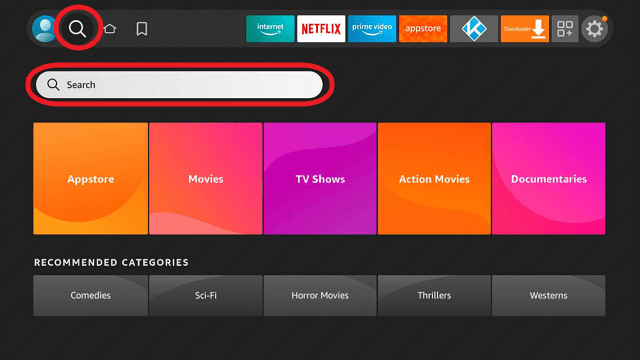
3. Type in the keyword of SurfShark and select from the suggestions that will appear.

4. Click the official SurfShark icon from your search results.

5. Press the Download (You own it) button.

6. The SurfShark VPN installer will download on your device.

7. SurfShark VPN’s app will automatically install itself on your Fire TV stick.

8. Press the Open button after completing SurfShark VPN’s installation process.

9. Please wait for the SurfShark VPN to load its user interface.

10. You can now log in with your SurfShark VPN account credentials.

Learn more about Surfshark and Grab the Best Surfshark Deal Now!
Install Surfshark on Firestick


For more VPN discounts, go to ReviewVPN Deals and purchase the best VPN for you.
Click here to get the lowest price on Surfshark through our exclusive limited-time offer.
Can Browser Extensions also encrypt your internet traffic?
Overall, we don’t suggest using browser extensions for encrypting your internet traffic entirely. However, there are browser extensions that will upgrade your HTTP connection to an HTTPS connection.
What is an Encrypted Web address?
An encrypted web address presents an SSL certificate that assures that your website and connection have excellent encryption protocols.
Conclusion
Encrypting your internet traffic is a good practice to protect all of your data. There are many methods to encrypt your internet traffic and ensure that no third party can see your online activities. We warn you that not all of them are free and some features require payment.
We hope this article helps you encrypt your internet traffic. Thank you for reading!


